
Percentage Increase Calculator
Calculate your final grade in seconds with accurate results.
Supports assignments, quizzes, exams and weighted categories.
Use the calculator seamlessly on desktop, tablet and mobile.
Your scores are processed instantly and are never stored.
Our Percentage Increase Calculator helps you determine how much a value has grown compared with its original amount in just a few seconds. Whether you’re analyzing a salary raise, tracking business revenue, comparing product prices, or reviewing investment performance, this tool removes the need for manual calculations.
Also Check this:
Many people struggle with figuring out the percent increase because the formula can seem confusing when working with different numbers and growth rates.
A reliable Percentage Increase Calculator is useful for students, business owners, investors, accountants, marketers, and anyone who needs to measure growth between two values. From monthly sales to year-over-year performance, understanding percentage growth can make comparisons clearer.
What is a Percentage Increase?
A percentage increase measures how much a value has grown relative to its original amount. Instead of looking only at the numerical difference, the percentage increase shows the growth as a percentage, making it easier to compare changes across different values.
For example, if a product price increases from $100 to $120, the increase is $20. However, the 20% increase provides a clearer understanding of the growth rate.
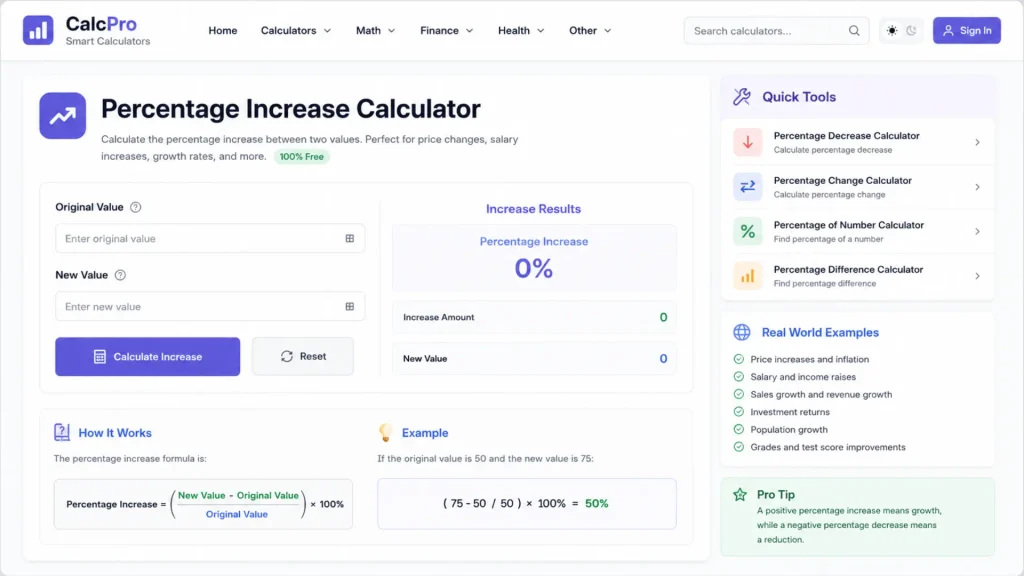
Definition of Percentage Increase
The percentage increase represents the amount of growth from an original value to a new value, expressed as a percentage of the original value.
Example:
- Original Value = 50
- New Value = 75
Increase = 75 − 50 = 25
Percentage Increase = 50%
This method is commonly used to calculate percentage increases for prices, salaries, revenue, grades, and investments.
Why Percentage Increase Matters
Understanding percentage growth helps people make better decisions based on data rather than raw numbers.
Common uses include:
- Salary and wage increases
- Business revenue growth
- Product price changes
- Investment performance
- Population growth
- Academic score improvements
When figuring the percent increase, percentages provide a more meaningful comparison than simply looking at the numerical difference.
Percentage Increase vs Absolute Increase
Many people confuse percentage increase with absolute increase, but they measure different things.
How to Calculate Percentage Increase
Learning how to calculate a % increase is straightforward once you understand the process. Whether you’re comparing prices, salaries, profits, or test scores, the same method applies. While a Percentage Increase Calculator can provide instant results, knowing the steps helps you verify your answers and understand the growth rate more clearly.
Start by subtracting the original value from the new value.
The difference, 50, is the amount of increase.
Next, divide the increase by the original value.
This converts the increase into a proportion of the original amount.
Multiply the result by 100 to convert the proportion into a percentage.
The value increased by 50% from the original amount.
Manual Example
Let’s work through a complete example.
Scenario:
A company’s monthly revenue increases from $2,000 to $2,500.
A student who gets 3 of 20 questions wrong answers 17 correctly, producing an 85% score. A standard grading scale would usually place this in the B range.
When a final exam is worth 30% of the course grade, a calculator can work backward from the desired 85% final result to estimate the score needed on the exam.
If homework averages 92% and contributes 25% of the course grade, its weighted contribution is 23 points toward the final grade.
Combining quizzes, homework, midterms, and finals with their respective weights provides an overall semester estimate and makes academic progress easier to track.
Percentage Increase Formula
The formula for percentage increase measures how much a value has grown relative to its original amount. Whether you’re calculating salary growth, revenue increases, investment gains, or price changes, this formula provides a consistent way to express growth as a percentage.
A Percentage Increase Calculator uses the same formula to generate instant, accurate results.
Standard Formula for Percentage Increase
The most widely used percentage of increase formula is:
[\text{Percentage Increase} = \frac{\text{New Value} – \text{Original Value}}{\text{Original Value}} \times 100]
This formula compares the increase to the original value and converts the result into a percentage.
Percentage of Increase Formula Explained
The formula consists of three simple parts:
- Find the increase:
- Increase = New Value − Original Value
- Divide the increase by the original value.
- Multiply by 100 to convert the result into a percentage.
This process helps accurately calculate percentage increase in almost any situation involving growth.
Formula Breakdown with Example
Example:
- Original Value = 80
- New Value = 100
Step 1: Find the Increase
100 − 80 = 20
Step 2: Divide by Original Value
20 ÷ 80 = 0.25
Step 3: Multiply by 100
0.25 × 100 = 25%
Percentage Increase = 25%.
Quick Reference Formula
|
Component |
Formula |
|
Increase |
New Value − Original Value |
|
Growth Ratio |
Increase ÷ Original Value |
|
Percentage Increase |
Growth Ratio × 100 |
Understanding this formula for percentage increase makes it easier to verify results, avoid calculation errors, and confidently determine the percent increase in academic, financial, and business scenarios.
Common Percentage Increase Examples
One of the easiest ways to understand percentage growth is by looking at real-world examples. These examples show how to calculate percentage increase in everyday situations such as salary raises, price changes, business growth, and investments. While you can calculate them manually, a Percentage Increase Calculator can produce the same results instantly.
Suppose your annual salary increases from $40,000 to $48,000.
A product’s price rises from $50 to $65.
A business increases monthly revenue from $10,000 to $12,500.
An investment grows from $5,000 to $6,250.
| Original Value | New Value | Percentage Increase |
|---|---|---|
| 100 | 110 | 10% |
| 100 | 125 | 25% |
| 100 | 150 | 50% |
| 200 | 300 | 50% |
| 500 | 750 | 50% |
| 1,000 | 1,200 | 20% |
Percentage Increase Conversion Table
A percentage increase table helps you quickly estimate growth without having to perform manual calculations each time. While a Percentage Increase Calculator provides precise results, these reference examples can help you understand common percentage increases at a glance.
| Original Value | New Value |
|---|---|
| 100 | 105 |
| 200 | 210 |
| 500 | 525 |
| 1,000 | 1,050 |
A 5% increase means the value grows by 5 for every 100 units.
| Original Value | New Value |
|---|---|
| 100 | 110 |
| 200 | 220 |
| 500 | 550 |
| 1,000 | 1,100 |
This is a common calculation when businesses calculate percentage increase for prices, sales, and revenue.
| Original Value | New Value |
|---|---|
| 100 | 125 |
| 200 | 250 |
| 500 | 625 |
| 1,000 | 1,250 |
A 25% increase adds one-quarter of the original value.
| Original Value | New Value |
|---|---|
| 100 | 150 |
| 200 | 300 |
| 500 | 750 |
| 1,000 | 1,500 |
When figuring percent increase, a 50% increase means adding half of the original value.
| Original Value | New Value |
|---|---|
| 100 | 200 |
| 200 | 400 |
| 500 | 1,000 |
| 1,000 | 2,000 |
A 100% increase means the value doubles because the entire original amount is added again.
| Increase | Growth Multiplier |
|---|---|
| 5% | 1.05× |
| 10% | 1.10× |
| 20% | 1.20× |
| 25% | 1.25× |
| 50% | 1.50× |
| 75% | 1.75× |
| 100% | 2.00× |
Percentage Increase Calculator for Business and Finance
Percentage increase calculations play a major role in business, finance, marketing, and investing. Companies use growth percentages to evaluate performance, measure profitability, and forecast future results. A Percentage Increase Calculator makes these calculations quick and accurate, helping decision-makers analyze trends without manual calculations.
Revenue Growth Analysis
Businesses often track revenue growth to measure success over time.
Example:
- Previous Revenue = $50,000
- Current Revenue = $65,000
Calculation:
- Increase = $15,000
- $15,000 ÷ $50,000 = 0.30
- 0.30 × 100 = 30%
Revenue Increase = 30%
This is one of the most common ways businesses calculate percentage increase when reviewing monthly, quarterly, or annual performance.
Sales Growth Tracking
Sales teams regularly monitor percentage growth to determine whether products and services are performing well.
Example:
- Last Month Sales = 800 Units
- This Month Sales = 1,000 Units
Calculation:
- Increase = 200
- 200 ÷ 800 = 0.25
- 0.25 × 100 = 25%
Sales Increase = 25%
Salary and Wage Increases
Employers and employees often need to figure out percent increase after a raise.
Example:
- Previous Salary = $45,000
- New Salary = $49,500
Calculation:
- Increase = $4,500
- $4,500 ÷ $45,000 = 0.10
- 0.10 × 100 = 10%
Salary Increase = 10%
Investment Growth
Investors use percentage increase calculations to evaluate returns on stocks, mutual funds, real estate, and other investments.
Example:
- Initial Investment = $10,000
- Current Value = $12,500
Calculation:
- Increase = $2,500
- $2,500 ÷ $10,000 = 0.25
- 0.25 × 100 = 25%
Investment Growth = 25%
Price Increase Analysis
Businesses frequently analyze product pricing changes using the formula for percentage increase.
| Original Price | New Price | Percentage Increase |
| $20 | $22 | 10% |
| $50 | $60 | 20% |
| $100 | $125 | 25% |
| $200 | $300 | 50% |
Why Businesses Use Percentage Increase
Percentage increase calculations help organizations:
- Measure revenue growth
- Track sales performance
- Analyze profit trends
- Compare investment returns
- Evaluate salary adjustments
- Monitor pricing strategies
Whether you’re a business owner, manager, investor, or employee, a Percentage Increase Calculator provides a simple way to measure growth and make data-driven decisions with confidence.
Percentage Increase vs Percentage Change
Many people use the terms percentage increase and percentage change interchangeably, but they are not always the same. Understanding the difference helps you apply the correct calculation when analyzing growth or decline.
What is a Percentage Increase?
Percentage increase measures only positive growth between an original value and a new value. It shows how much a value has increased relative to its starting point.
Example:
- Original Value = 100
- New Value = 125
Increase = 25
Percentage Increase = (25 ÷ 100) × 100 = 25%
This is the method used by a Percentage Increase Calculator.
What Is Percentage Change?
Percentage change measures both increases and decreases. It tells you how much a value has changed from its original amount, regardless of whether the result is positive or negative.
Example (Increase):
- Original Value = 100
- New Value = 120
Percentage Change = +20%
Example (Decrease):
- Original Value = 100
- New Value = 80
Percentage Change = -20%
Percentage Increase vs Percentage Change Comparison
| Metric | Percentage Increase | Percentage Change |
|---|---|---|
| Measures Growth | ✓ Yes | ✓ Yes |
| Measures Decrease | ✕ No | ✓ Yes |
| Positive Values Only | ✓ Yes | ✕ No |
| Business Growth Analysis | Common | Common |
| Price Reduction Analysis | ✕ No | ✓ Yes |
- ✓ Sales increase
- ✓ Revenue grows
- ✓ Salary rises
- ✓ Investment value increases
- ✓ Population expands
- ✓ Comparing any two values
- ✓ Measuring gains and losses
- ✓ Tracking stock market performance
- ✓ Analyzing business trends
- ✓ Reviewing price increases and decreases
Research from the Education Endowment Foundation’s Teaching & Learning Toolkit reports an average +6 months of progress for feedback across 155 studies, highlighting the importance of feedback in supporting student learning.
Common Mistakes When Calculating Percentage Increase
Although the calculation is straightforward, many people make mistakes when trying to calculate percentage increase manually. These errors can lead to inaccurate results and poor decision-making, especially in finance, business, and academic settings.
Using the New Value Instead of the Original Value
One of the most common mistakes is dividing by the new value rather than the original value.
Incorrect Calculation:
- Original Value = 100
- New Value = 150
- Increase = 50
Wrong:
50 ÷ 150 × 100 = 33.3%
Correct:
50 ÷ 100 × 100 = 50%
Always use the original value when applying the percentage of increase formula.
Confusing Percentage Increase with Percentage Difference
Many people mistakenly calculate percentage difference when they actually need percentage increase.
Percentage increase measures growth from an original value, while percentage difference compares two values without focusing on a starting point.
Understanding this distinction is essential when figuring percent increase accurately.
After dividing the increase by the original value, the answer is still a decimal rather than a percentage.
If the new value is lower than the original value, the result represents a decrease rather than an increase.
Rounding intermediate values before completing the full calculation can introduce small errors into the final result.
People searching for how to calculate a increase sometimes use a formula intended for percentage difference or percentage decrease instead.
Simple growth calculations can often be done manually, but larger numbers, decimals, and repeated calculations make mistakes more likely. A Percentage Increase Calculator can perform the same calculation instantly for business, financial, educational, and personal use.
Percentage Calculator
A Percentage Calculator helps determine percentages, percentage differences, percentage increases, and percentage decreases.
Best for:
- Discounts and sales
- Exam scores
- Financial calculations
- Business reports.
Percentage Decrease Calculator
A Percentage Decrease Calculator measures how much a value has fallen from its original amount.
Example Uses:
- Price reductions
- Revenue declines
- Investment losses
- Expense reductions
Percentage Change Calculator
Unlike a Percentage Increase Calculator, a Percentage Change Calculator measures both increases and decreases between two values.
Best for:
- Market analysis
- Stock performance
- Business trend tracking
- Financial reporting
A Percentage Difference Calculator compares two values and expresses the difference between them as a percentage.
- ✓ Comparing products
- ✓ Scientific measurements
- ✓ Data analysis
- ✓ Statistical reporting
Businesses use a Markup Calculator to determine how much a selling price should increase above the product’s cost.
- ✓ Retail pricing
- ✓ Profit planning
- ✓ Inventory management
A Profit Margin Calculator helps determine profitability by comparing revenue with costs and measuring the resulting margin.
- ✓ Business analysis
- ✓ Financial planning
- ✓ Sales performance reviews
A Compound Growth Calculator measures growth across multiple periods and is commonly used for investments and forecasting.
- ✓ Investment returns
- ✓ Business growth projections
- ✓ Savings calculations
- ✓ Long-term financial planning
Frequently Asked Questions
Here are some helpful explanations to guide you through common queries.
Using The Grading Calculator
Features
Accuracy
Use Cases
Final Thoughts
A Percentage Increase Calculator makes it easy to measure growth between two values without performing complex manual calculations. Whether you’re learning how to calculate a % increase, applying the formula for percentage increase, or trying to figure out the percentage increase for salaries, prices, revenue, or investments, understanding percentage growth helps you make better decisions. By using the correct percentage of increase formula, you can accurately track performance, compare results, and analyze trends. For fast, reliable results, a Percentage Increase Calculator is the simplest way to calc percent increase and evaluate growth with confidence.